


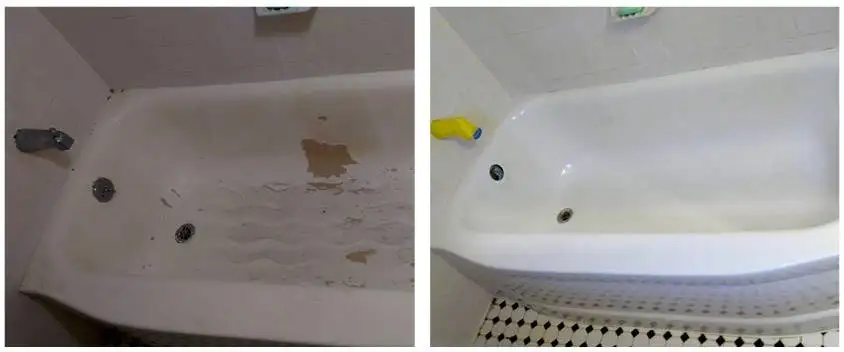
Bathtub Refinishing vs. Replacement: An Honest Cost and Outcome Comparison for Chicago Homeowners
You’re staring at a stained, chipped, or discolored bathtub and wondering whether to refinish it or rip it out entirely. It’s one of the most common bathroom dilemmas, and the answer depends on more than just price. This guide breaks down the real costs, timelines, disruption levels, and long-term outcomes of each option so you can make the right call for your specific situation.
What Each Option Actually Costs in the Chicago Area
The cost gap between refinishing and replacement is significant, but the headline numbers only tell part of the story. Here’s what Chicago-area homeowners should budget for each option in 2026, including the hidden line items most guides leave out.
| Cost Category | Refinishing | Full Replacement |
|---|---|---|
| Base service / tub cost | $350–$600 | $200–$2,000 (tub only) |
| Labor | Included in base | $500–$2,000 |
| Plumbing modifications | $0 | $200–$1,500 |
| Demolition and disposal | $0 | $200–$500 |
| Wall/tile repair | $0 | $300–$2,500 |
| Galvanized pipe replacement (pre-1960s homes) | $0 | $2,500–$4,000 |
| Chicago sales tax (10.25%) | Applies to materials | Applies to fixtures and materials |
| Typical total project cost | $350–$600 | $2,500–$10,500 |
The line item that catches most Chicago homeowners off guard is the galvanized pipe situation. If your home was built before the mid-1960s, and many Chicago bungalows, two-flats, and greystones were, your plumber may discover corroded galvanized supply lines or cast iron drain stacks once the old tub comes out. That discovery alone can add $2,500 to $4,000 to a replacement project. With refinishing, those pipes stay undisturbed.
How Long Does Each Option Last?
A professionally refinished bathtub lasts 10 to 15 years with proper care. A brand-new bathtub, depending on material, lasts 20 to 30 years or more. But those numbers need context.
The lifespan of a refinished tub depends almost entirely on two factors: the quality of the prep work and what cleaning products you use afterward. A professional who acid-etches the surface, applies a bonding agent, and sprays a two-part urethane coating will produce a surface that wears like a factory finish. A company cutting corners with roller-applied epoxy will give you a finish that starts peeling within two years.
For replacement, material matters enormously. A cast iron tub with porcelain enamel can outlast the house. A builder-grade fiberglass insert might flex and crack within 15 years, especially in a second-floor bathroom where the subfloor has any give. So “new” does not automatically mean “longer lasting” unless you’re comparing equivalent quality levels.
| Factor | Refinishing | Replacement |
|---|---|---|
| Expected lifespan | 10–15 years | 20–30+ years |
| Warranty (typical professional) | 5–10 years | 1–5 years (manufacturer) |
| Can be re-refinished? | Yes, 1–2 more times | N/A |
| Biggest lifespan killer | Abrasive cleaners, bath mats with suction cups | Cheap material, poor installation |
One detail worth noting: a refinished tub can be refinished again. If you get 12 years out of the first refinish and then refinish again, you’ve potentially gotten 22 to 25 years of use out of the original tub for a combined spend of roughly $700 to $1,200. That’s still a fraction of a single replacement project.
Timeline and Disruption: One Day vs. One Week
Refinishing a standard bathtub takes 3 to 5 hours of on-site work. You can use the tub again within 24 to 48 hours after the coating cures. The rest of your bathroom remains fully functional during the process.
Replacement is a different story. Even a straightforward swap, same footprint, no plumbing changes, takes 2 to 3 days minimum. If the project involves moving the drain, repairing subfloor damage, retiling the surround, or replacing pipes, you’re looking at 5 to 7 days or more. During that time, the bathroom is completely out of service.
For a household with one bathroom, that distinction matters enormously. For a rental property between tenants, every day of vacancy costs money. For a family with young kids, losing the only bathtub for a week creates real logistical headaches that don’t show up on the contractor’s estimate.
The Break-Even Math: When Replacement Actually Makes Financial Sense
Here’s the calculation most comparison guides skip. If refinishing costs $475 (the Chicago-area average) and lasts 12 years, your annual cost of ownership is about $40 per year. If replacement costs $5,000 (a mid-range Chicago project) and the new tub lasts 25 years, your annual cost is $200 per year.
Refinishing wins the per-year cost comparison by a factor of five. Even in the most favorable replacement scenario, say a $2,500 basic swap that lasts 30 years, you’re still at $83 per year versus $40 for refinishing.
Replacement starts making financial sense in exactly three scenarios:
- The tub has structural damage. Cracks that go through the tub wall, rusted-through steel, or a fiberglass shell that flexes when you step in. No coating can fix a structural problem.
- You’re already gutting the bathroom. If you’re replacing tile, vanity, toilet, and flooring anyway, the incremental cost of swapping the tub drops significantly because demolition and tile work are already in the budget.
- You want a completely different tub configuration. Going from an alcove tub to a freestanding soaker, or from a tub to a walk-in shower, requires replacement by definition.
Outside of those three situations, refinishing delivers more value per dollar spent.
What the Refinishing Process Looks Like (and Why Prep Work Matters More Than the Coating)
A quality refinishing job follows a specific sequence. Understanding it helps you evaluate contractors and spot corner-cutters.
The technician starts by cleaning the tub with an industrial degreaser to remove soap scum, body oils, and mineral deposits. Next comes repair work: chips, scratches, and minor surface damage get filled with a catalyzed body filler and sanded smooth. The entire surface is then acid-etched or sanded with 80- to 120-grit paper to create a profile for the new coating to bond to.
After prep, a bonding agent goes on, followed by multiple coats of a two-part urethane or acrylic urethane finish, sprayed with an HVLP (high-volume, low-pressure) gun. Professional-grade coatings build to 4 to 6 mils of thickness, which is what gives the finish its durability and gloss.
The prep work accounts for about 60% of the total job time and is the single biggest predictor of how long the finish will last. A company that shows up and starts spraying within 20 minutes is skipping steps that matter. At Aarco Baths, the prep process follows a protocol developed over six decades, which is part of why the company backs every job with a full 10-year guarantee.
Safety and Ventilation: What Changed After the EPA Methylene Chloride Ban
In April 2024, the EPA finalized a ban on most consumer and commercial uses of methylene chloride, a solvent previously used by some refinishing companies as a paint stripper. This was driven by documented fatalities in poorly ventilated bathrooms where the chemical was used without proper respiratory protection.
Reputable refinishing companies had already moved away from methylene chloride years before the ban. Modern professional refinishers use water-based or low-VOC strippers and two-part urethane coatings that, while still requiring ventilation during application, pose far lower health risks than the old methylene chloride process.
When vetting a refinishing contractor, ask specifically what stripping agent and coating system they use. A professional operation will use a dedicated mobile exhaust ventilation unit with flexible ductwork that vents fumes directly outside, not just an open window and a box fan. This is one of the clearest quality signals in the industry.
Chicago-Specific Factors That Tilt the Decision
Several factors unique to the Chicago housing market make refinishing an especially strong option in this area.
Housing stock age. A significant portion of Chicago’s housing inventory was built between 1900 and 1960. These homes commonly have heavy cast iron tubs with porcelain enamel finishes. These tubs are structurally excellent but cosmetically tired. Refinishing restores the appearance while preserving a tub that’s often higher quality than anything you’d replace it with at a comparable price point. Many of the cast iron tubs in Chicago bungalows and greystones weigh 300 to 500 pounds, and removing one from a second-floor bathroom is a significant demolition project in itself.
Two-flats and multi-unit buildings. Chicago has thousands of owner-occupied two-flats where the owner lives in one unit and rents the other. Refinishing every tub in a multi-unit building costs a fraction of replacement and can be done unit by unit with minimal tenant disruption. Aarco Baths serves both residential and commercial properties across the Chicago metro, with studios in Chicago, Addison, and Naperville.
Permit requirements. In Chicago, plumbing work associated with a tub replacement typically requires a permit from the Department of Buildings. Refinishing, because it doesn’t involve plumbing or structural changes, requires no permits. That saves both money and time navigating Chicago’s permitting process.
Lead paint considerations. Homes built before 1978 may have lead paint on or around the bathtub. A full replacement that involves demolition can disturb lead paint and trigger EPA RRP (Renovation, Repair, and Painting) rule requirements, adding cost and complexity. Refinishing encapsulates the existing surface without demolition, which avoids disturbing any underlying lead paint layers.
A Side-by-Side Decision Matrix
Use this table to quickly determine which option fits your situation. Find the row that matches your scenario and follow the recommendation.
| Your Situation | Best Option | Why |
|---|---|---|
| Stained, discolored, or chipped surface | Refinish | Cosmetic damage is exactly what refinishing fixes best |
| Dated color (pink, avocado, harvest gold) | Refinish | Color change to white or almond for $350–$600 vs. $3,000+ |
| One bathroom, can’t afford downtime | Refinish | Back in service within 24–48 hours vs. 5–7 days |
| Rental property between tenants | Refinish | Fastest turnaround, lowest cost, minimal vacancy |
| Heavy cast iron tub in good structural shape | Refinish | The tub itself is better than most replacements; just renew the surface |
| Crack through the tub wall | Replace | Structural failure requires a new fixture |
| Full bathroom gut renovation | Replace | Incremental cost drops when demo is already happening |
| Want a different tub type or layout | Replace | Refinishing can’t change the tub’s shape or position |
| Selling the home within 6 months | Refinish | Maximum ROI for cosmetic refresh before listing |
| Flipping and doing a full remodel | Replace | Buyers of fully remodeled homes expect new fixtures |
Our Cross-Reference: What Two Refinishes Cost vs. One Replacement Over 25 Years
We ran the numbers on a 25-year cost-of-ownership comparison using Chicago-area pricing to show the full financial picture beyond the initial project cost.
| Scenario | Year 0 Cost | Year 12 Cost | 25-Year Total | Annual Cost |
|---|---|---|---|---|
| Refinish now + refinish again at year 12 | $475 | $525 (inflation-adjusted) | $1,000 | $40/yr |
| Mid-range replacement (new acrylic tub) | $5,000 | $0 | $5,000 | $200/yr |
| Budget replacement (basic fiberglass insert) | $2,500 | $0 | $2,500 | $100/yr |
| Premium replacement (cast iron, tile surround) | $8,500 | $0 | $8,500 | $340/yr |
Even accounting for a second refinish at year 12, the refinishing path costs 60% to 88% less than any replacement scenario over a 25-year window. The only scenario where replacement closes the gap is the budget fiberglass insert, but that option comes with its own downsides: shorter lifespan, lower perceived quality, and potential flexing issues in older homes with imperfect subfloors.
How to Vet a Refinishing Contractor (So You Don’t End Up Needing a Replacement Anyway)
A bad refinishing job is worse than no refinishing job at all. Peeling, bubbling, or rough finishes are almost always the result of poor prep work or low-quality coatings. Here are the questions to ask before hiring anyone:
- What coating system do you use? Look for two-part urethane or acrylic urethane. Avoid anyone using single-part epoxy from a hardware store.
- How long is your prep process? Quality prep takes 1.5 to 2.5 hours. If they claim they can refinish a tub in under two hours total, they’re skipping steps.
- What’s your warranty? Reputable companies offer 5 to 10 years. Aarco Baths provides a full 10-year guarantee backed by over 60 years of continuous operation in the Chicago area.
- How do you handle ventilation? The right answer involves a mobile exhaust unit, not “we open the window.”
- Can you show me before-and-after photos of similar tubs? Ask for photos of tubs similar to yours, not just their best showcase piece. Check the Aarco Baths gallery for examples of real project results.
- What happens if the finish fails within the warranty period? Get the warranty terms in writing, including what voids it (usually abrasive cleaners and suction-cup mats).
Frequently Asked Questions
Is it cheaper to refinish or replace a bathtub?
Refinishing is significantly cheaper. In the Chicago area, refinishing costs $350 to $600, while a full replacement runs $2,500 to $10,500 depending on plumbing complexity and whether wall/tile repair is needed. Refinishing saves 75% or more compared to replacement in most cases.
How long does a refinished bathtub last compared to a new one?
A professionally refinished bathtub lasts 10 to 15 years with proper maintenance. A new bathtub lasts 20 to 30 years depending on material. However, a refinished tub can be refinished again, so two refinish cycles can cover 20 to 25 years at a fraction of replacement cost.
Can you refinish a bathtub that has already been refinished?
Yes, a tub can typically be refinished one to two additional times after the original refinish. The key is that the old coating must be fully stripped and the surface properly re-prepped before each new application. After two or three total refinishes, the buildup of old coating layers can create adhesion problems, at which point replacement becomes the better option.
Does bathtub refinishing add value to a home?
Refinishing improves the appearance of a dated bathroom at minimal cost, which can help a home show better to buyers. It won’t add the same value as a full bathroom remodel, but for sellers looking to maximize ROI on pre-listing improvements, a $400 to $500 refinish that makes a stained or chipped tub look new is one of the highest-return cosmetic upgrades available.
What voids a bathtub refinishing warranty?
The most common warranty voids are using abrasive cleaners (Comet, Ajax, or anything with grit), placing bath mats with suction cups on the refinished surface, using drain-clearing chemicals that splash onto the finish, and allowing standing water with harsh chemicals to sit for extended periods. Most warranties specify using only non-abrasive cleaners and a soft sponge.
Do I need a permit for bathtub refinishing in Chicago?
No. Bathtub refinishing does not require a permit in Chicago because it involves no plumbing, electrical, or structural modifications. Bathtub replacement, on the other hand, typically requires a plumbing permit from the Chicago Department of Buildings if any plumbing connections are altered.
The Bottom Line
For the vast majority of Chicago homeowners dealing with a stained, chipped, discolored, or outdated bathtub, refinishing is the smarter financial decision. It costs 75% to 90% less, takes one day instead of one week, requires no permits, and produces a surface that looks and wears like a new tub for 10 to 15 years.
Replacement makes sense in a narrow set of circumstances: structural damage, full bathroom renovations, or a desire to change the tub’s configuration entirely. Outside of those cases, the math overwhelmingly favors refinishing.
If you’re unsure which option fits your situation, a free estimate from a professional refinishing company can help you evaluate the condition of your tub and make an informed decision. Aarco Baths has been refinishing bathtubs in the Chicago area since 1963 and will give you an honest assessment of whether refinishing or replacement is the right call for your specific tub.

