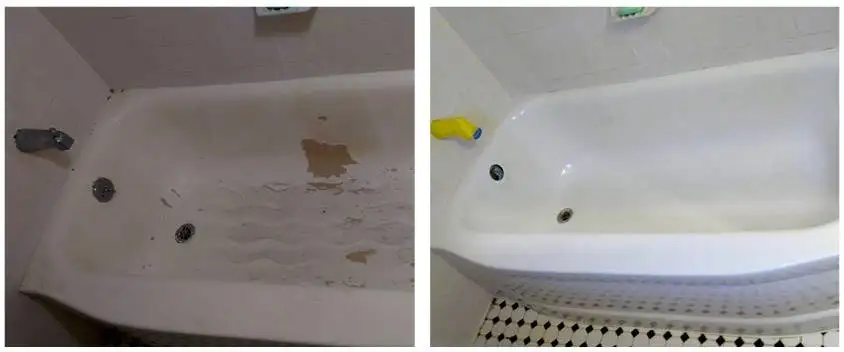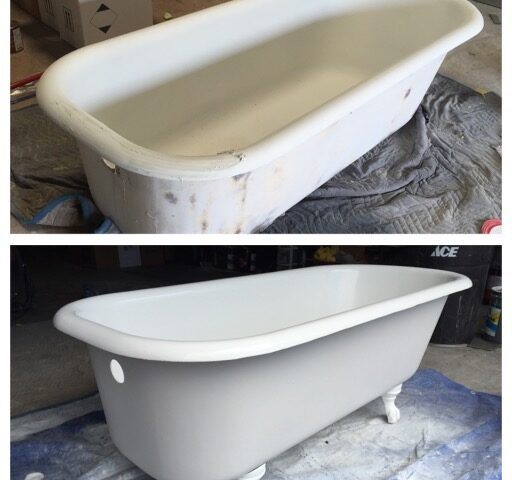
Refinishing a Cast Iron Bathtub: What Chicago Homeowners Should Know Before Hiring Anyone
This guide walks through why cast iron is the ideal refinishing candidate, what the process actually looks like, realistic costs in the Chicago market, how long the finish holds up, and the specific questions to ask a contractor before signing anything.
Why Cast Iron Is the Best Material for Refinishing
Cast iron bathtubs were made by pouring molten iron into a sand mold, then coating the finished shell with a vitreous porcelain enamel fused to the metal at roughly 2,000°F. The iron shell weighs 300 to 500 pounds and does not flex, crack, or shift under load. That matters for refinishing because modern coatings need a rigid, stable substrate to bond to. Fiberglass and acrylic tubs flex slightly when you step into them, which stresses the coating over time. Cast iron does not move.
The porcelain enamel surface also responds well to the chemical etching step in professional refinishing. Etching roughens the existing finish at a microscopic level so the new coating can grip. Porcelain etches cleanly and uniformly. Fiberglass and acrylic require different prep chemistry and are less forgiving when the technician is rushed. If you have cast iron, you have the best possible starting point.
One quick test to confirm your tub is cast iron: tap the side with a coin. Cast iron produces a dull, dense thud. Steel tubs with porcelain enamel (common in postwar tract homes) ring with a higher, tinnier note. A magnet will stick to both, but only cast iron has the weight and dead-sound signature. If you can see the underside through a basement ceiling or access panel, cast iron looks like rough, pebbled black metal.
What Does Refinishing a Cast Iron Tub Actually Cost?
In the Chicago metro, a professional cast iron tub refinishing job typically runs between $400 and $700. Standard 5-foot alcove tubs sit at the lower end. Clawfoot tubs, which require refinishing the outside as well as the inside, run higher. Tubs with significant chips, rust spots, or prior amateur refinishing that must be stripped push the price up further.
Compare that to the full cost of replacement. A new cast iron tub alone runs $600 to $2,500, and you cannot lift one up a flight of stairs without a crew. Removing an old cast iron tub from a second-floor bathroom in a Chicago two-flat almost always means breaking it up with a sledgehammer inside the bathroom, then hauling the pieces out in buckets. Add demolition, plumbing modifications, tile repair, disposal fees, and a contractor’s time, and the typical all-in replacement cost lands between $3,500 and $8,000 depending on access and finish work.
| Cost Factor | Professional Refinishing | Full Replacement |
|---|---|---|
| Typical total cost | $400–$700 | $3,500–$8,000+ |
| Time on site | 4–6 hours | 2–5 days |
| Days the tub is unusable | 1–2 (cure time) | 3–7 (plumbing and tile) |
| Plumbing disruption | None | Drain and overflow rebuild required |
| Tile damage likely? | No | Yes (repair or retile the surround) |
| Demolition debris | None | 300–500 lb of broken iron and tile |
| Expected lifespan of finish | 10–15 years with proper care | 30+ years on a new tub |
The math tilts heavily toward refinishing for nearly every cast iron tub that is structurally sound. The exception is a tub with rust-through holes, deep cracks, or a drain configuration you need to move. Everything else is cheaper to restore.
The Refinishing Process, Step by Step
A proper cast iron refinishing job is not a paint job. It is a multi-stage chemical and mechanical process that takes an experienced technician four to six hours from start to cleanup. Here is what actually happens.
Step 1: Masking and ventilation. The technician protects the floor, tile, fixtures, and walls with plastic sheeting and tape. Windows are opened and an exhaust fan is set up. The spraying phase later in the process uses materials that require active ventilation.
Step 2: Caulk and hardware removal. Old silicone caulk around the tub is cut out, and drain and overflow covers are unscrewed. These are reinstalled or replaced at the end, depending on their condition.
Step 3: Deep cleaning and degreasing. Years of soap film, body oils, and cleaning product residue are removed with a strong degreaser. Any contamination left behind will prevent the new coating from bonding, so this step is not optional.
Step 4: Chip and rust repair. Chips in the porcelain are filled with a polyester bonding filler, sanded flush, and feathered into the surrounding surface. Small rust spots are treated with a converter and sealed. Larger pitted areas are filled and leveled.
Step 5: Chemical etching. An acidic etch is applied to the porcelain to create a microscopic bonding profile. This is the step that separates durable refinishing from a quick DIY spray job. Without proper etching, the new coating peels within months.
Step 6: Primer application. A bonding primer is sprayed on in a thin, even coat and allowed to flash off. This layer is what the topcoat grips onto.
Step 7: Topcoat spraying. Multiple thin coats of the refinishing material, usually a two-part urethane or acrylic urethane, are sprayed on in a controlled pattern. Each coat is allowed to flash before the next is applied. Total build is typically 4–6 mils.
Step 8: Curing and reassembly. The tub must sit untouched for 24 to 48 hours while the coating fully hardens. After cure, the drain and overflow hardware are reinstalled and fresh caulk is applied.
The whole process is invisible to a homeowner until the masking comes off, which is why vetting the contractor matters so much. You cannot tell from the finished surface whether steps 3 and 5 were done thoroughly or rushed. That is the central question you are paying to have answered correctly.
How Long Does a Refinished Cast Iron Tub Last?
A properly refinished cast iron tub typically holds up for 10 to 15 years before needing another refresh. Some jobs go longer. The lifespan depends on three things: the quality of the prep work, the quality of the coating material, and how the tub is cleaned and used after the job is done.
Cast iron has a structural advantage here that fiberglass and acrylic tubs do not. Because the substrate does not flex, there is no stress on the coating when someone steps into the tub. Most coating failures on non-cast-iron tubs start as hairline cracks where the substrate moved. On cast iron, failures tend to start at the drain area where standing water sits, or around chips that were not properly repaired before recoating.
Aarco Baths backs their work with a 10-year written guarantee, which is the Chicago industry standard for quality work. A guarantee that short of 10 years, or one that is verbal only, is a warning sign.
Chicago Housing Stock: Why Cast Iron Is Everywhere Here
Chicago’s residential building boom from roughly 1890 through the late 1950s coincided almost perfectly with the era when cast iron was the default bathtub material. That means the city’s signature housing types, the two-flats and three-flats of the North and West sides, the bungalows of the Bungalow Belt, the courtyard apartment buildings of Rogers Park and Uptown, the greystones of Logan Square, the brick walk-ups of Pilsen and Bridgeport, the Victorian and Queen Anne homes of Oak Park, Evanston, and Wilmette, were all plumbed with cast iron tubs when they were built.
Most of those tubs are still in service 60 to 130 years later. The porcelain finish on a 1920s cast iron tub will eventually stain, yellow, and chip, but the iron underneath is typically fine. Homeowners who tear out a historic tub often regret it, because the replacement is usually a lighter, thinner-walled, stamped-steel or acrylic unit that feels cheap next to the original. Refinishing preserves the original fixture, which matters both for the feel of the bath and, in some cases, for the character of a landmark or historic-district home.
If you live in a Chicago neighborhood with older housing or in suburbs like Oak Park, Evanston, La Grange, Hinsdale, Downers Grove, or Naperville’s older sections, the odds that your tub is refinishable cast iron are very high. Aarco Baths operates studios in Chicago, Addison, and Naperville and services the entire metro area from those locations. A free in-home estimate will confirm the tub material and surface condition before any work is scheduled.
The Problems Refinishing Can Fix (and the Ones It Cannot)
Cast iron tubs arrive at the end of their finish life in fairly predictable ways. The good news is that most of these problems are straightforward to correct. A few are not.
| Problem | Refinishable? | What Happens |
|---|---|---|
| Yellowing from age or hard water | Yes | New coating restores bright white or a custom color |
| Surface stains that will not scrub out | Yes | The stained porcelain is covered entirely |
| Chips in the porcelain from dropped items | Yes | Filled, sanded, and recoated invisibly |
| Small rust spots at the drain or chips | Yes | Rust is neutralized and sealed before coating |
| Dulled, rough, no-longer-glossy surface | Yes | New high-gloss finish is indistinguishable from factory |
| Previous amateur refinishing that is peeling | Sometimes | Old coating must be stripped first; adds cost |
| Deep rust-through hole to the iron | No | Coating cannot bridge structural loss |
| Structural crack running through the tub | No | Rare on cast iron; indicates replacement |
| Wrong size or wrong drain location | No (replacement) | Refinishing does not change geometry |
If you are not sure which category your tub falls into, take clear photos of the damage and send them to a refinishing company before the estimate visit. A reputable shop will tell you over the phone or email if refinishing is not the right call, rather than selling you a job that will fail.
DIY Kits vs. Professional Refinishing: An Honest Comparison
Big-box stores sell cast iron refinishing kits in the $30 to $80 range, and home improvement forums are full of testimonials from homeowners who used one and are happy with the result. Some of those testimonials are six months old. Very few are five years old.
The honest tradeoffs break down like this. A DIY kit gives you a two-part epoxy coating, a rough etching product, a small roller or brush, and a couple of hours of instructions. The result can look acceptable on day one. The failure modes tend to emerge between 6 and 24 months later: peeling at the drain, yellowing in the basin, brush marks showing through, and a general loss of gloss. The underlying reason is usually that home kits do not include the commercial-grade etching, they rely on brushing or rolling rather than HVLP spraying (which produces a thinner, more uniform film), and they use materials with shorter service lives than professional coatings.
A DIY kit makes sense if you are planning to sell the house inside a year, if the tub is in a rarely-used guest bathroom, or if you simply enjoy the project and accept that you may be doing it again in two years. For a primary bathroom you will use every day, in a home you plan to live in, the professional job is the better economic choice over any five-year horizon. The cost per year of use is lower on the professional job once you factor in lifespan.
For a deeper comparison, our separate piece on DIY vs. professional bathtub refinishing walks through materials, failure rates, and real-world cost-per-year math.
Questions to Ask Before Hiring a Cast Iron Refinisher
Refinishing is a trade with a wide quality spread. The same job can be done brilliantly by one technician and poorly by another using the same materials. Here are the questions that separate the two.
How do you prep a cast iron tub specifically? A qualified technician should mention chemical etching, chip filling with polyester or epoxy filler, rust treatment at the drain, and degreasing. If the answer is just “we clean it and spray it,” keep calling.
What coating material do you use, and is it single-part or two-part? Professional refinishers almost universally use two-part (catalyzed) urethane or acrylic urethane coatings. Single-part products are for DIY kits.
Is the coating sprayed with HVLP, or brushed and rolled? Spraying produces a smoother, more uniform finish. Brushing and rolling leaves texture and is a red flag for professional work.
What ventilation do you set up during spraying? The correct answer involves opening windows, running an exhaust fan, and in some cases using a respirator mask for the technician. If there is no ventilation plan, the technician is not following safe practice.
How long before I can use the tub? Expect an answer of 24 to 48 hours. Shorter than that means the coating has not fully cured.
What warranty do you offer, and is it in writing? Ten years in writing is the standard for quality work in Chicago. Shorter or verbal-only is a warning sign.
Can I see photos of cast iron tubs you have refinished, and can I speak with a recent customer? A shop that does this work regularly will have both on hand immediately.
Are you licensed and insured in Illinois? Liability insurance matters because refinishing involves chemical products and spray application. Confirm the certificate of insurance before scheduling.
Caring for Your Refinished Cast Iron Tub
A newly refinished cast iron tub will last well into the second decade if you follow four simple rules. Ignore them and you can shorten the lifespan to three or four years.
Use only non-abrasive liquid cleaners. Dish soap, Soft Scrub liquid (not powder), Bar Keepers Friend Liquid, or a 50/50 vinegar-water solution are all safe. Avoid Comet, Ajax, any powdered scouring product, bleach-heavy cleaners, and “tub and tile” products that advertise calcium-dissolving power. The chemicals that attack mineral deposits also attack the coating.
No suction-cup bath mats. The cups grip the coating and pull at it every time you lift the mat. Over time this causes pinhole damage that propagates into peeling. Use a non-suction rubber mat or a cloth bath mat that sits loose on the surface.
No steel wool, Brillo pads, or Magic Erasers. All three are abrasive enough to scratch the coating. A soft sponge, a microfiber cloth, or a soft-bristle brush is all you need for routine cleaning.
Wipe the tub dry after each use. Standing water around the drain is the number one cause of premature coating failure. A quick wipe with a towel after each bath or shower adds years to the finish.
These rules are not unique to cast iron; they apply to any refinished tub. But because cast iron tubs tend to be in older homes with older plumbing, they often have slower drains where water sits longer. The wipe-down habit matters more in that environment.
When Refinishing Is Not the Right Call
There are a handful of situations where a reputable refinisher will tell you to replace the tub instead. A good company will have this conversation with you directly rather than taking the job and producing a short-lived result.
The tub has rusted through. If you can see light through a pinhole, or if there is a visibly thin, crumbling area of iron, the substrate has failed. Coating cannot bridge a hole.
You are gut-renovating the bathroom. If the tile is coming off, the subfloor is being replaced, or the layout is changing, the cost of removing and replacing the tub as part of a larger project may be a wash, and a fresh tub eliminates one more variable.
The tub has been refinished three or more times already. Each previous coating has to be stripped or bonded over. At some point the layers get thick enough and the adhesion history gets complicated enough that a fresh tub is cleaner.
You want a different tub configuration entirely. Moving from a standard alcove tub to a soaking tub, a walk-in shower, or a freestanding clawfoot means you are doing plumbing work regardless. Refinishing does not help.
The tub is in a short-term flip with a strict budget ceiling. For a flip where the buyer’s inspector will open every cabinet and flag every refinished surface, a new low-end tub may actually appraise better. For a property you plan to hold, refinishing almost always wins on economics.
Outside of those scenarios, refinishing a cast iron tub is one of the highest-ROI bathroom investments available in the Chicago market. You preserve a fixture that was built better than most new tubs, you save thousands versus replacement, and you avoid multi-day construction disruption.
Frequently Asked Questions
How long does refinishing a cast iron bathtub take?
The on-site work takes four to six hours for a standard cast iron tub, including prep, repair, etching, priming, and spraying. After the technician leaves, the coating needs 24 to 48 hours of cure time before the tub can be used. Plan on the tub being out of service for two days total.
Is refinishing a cast iron tub cheaper than replacing it?
Substantially. In the Chicago area, refinishing a cast iron tub typically costs $400 to $700, while removal and replacement runs $3,500 to $8,000 or more once you factor in demolition, plumbing, tile work, and disposal. On a structurally sound tub, refinishing is one of the highest-value bathroom decisions available.
Can you change the color of a cast iron bathtub during refinishing?
Yes. Custom colors are available at most professional shops, though white is the most common choice because it coordinates with any future tile or fixture updates. Ask for a color sample before committing to a non-standard shade.
Will the refinished surface feel different from the original porcelain?
The finish feels slightly warmer to the touch than original vitreous porcelain because the coating is less thermally conductive. It is smooth, high-gloss, and easy to clean. Most homeowners cannot tell the difference visually once the work is complete.
How do I know if my tub is actually cast iron?
Cast iron tubs are extremely heavy (300 to 500 lb), magnetic, and produce a dull thud when tapped with a coin. Steel tubs are also magnetic but ring with a higher, tinnier sound and are noticeably lighter. Fiberglass and acrylic tubs are not magnetic and flex slightly when you press on the side panel. If you can see the underside through a basement ceiling or access panel, cast iron looks like rough, unfinished black metal.
Does refinishing work on clawfoot cast iron tubs?
Yes, and clawfoot tubs are one of the most common cast iron refinishing jobs in Chicago’s older neighborhoods. The outside of a clawfoot tub is also refinished, which adds to the total job time and cost compared to an alcove tub where only the inside is coated. Expect a clawfoot refinishing job to run toward the higher end of the price range.
Can a chipped cast iron tub be refinished, or does the chip need to be repaired first?
Chip repair is part of the standard refinishing process. The technician fills the chip with a polyester bonding filler, sands it flush with the surrounding surface, and includes it in the full refinishing job. A tub with multiple chips or a cracked edge can still be refinished as long as the iron substrate is intact.
What is the best bathtub refinishing company in Chicago for cast iron work?
Look for a company with decades of specific cast iron experience, a written 10-year guarantee, HVLP spray application, two-part urethane coatings, and verifiable references. Aarco Baths has been refinishing cast iron bathtubs across the Chicago area since 1963 and operates studios in Chicago, Addison, and Naperville. An in-home estimate is free.